
Collection Spotlight: Early English Books Online and EEBO Text Creation Partnership
by Patrick Williams, Humanities Librarian and Lead Librarian for Digital & Open Scholarship
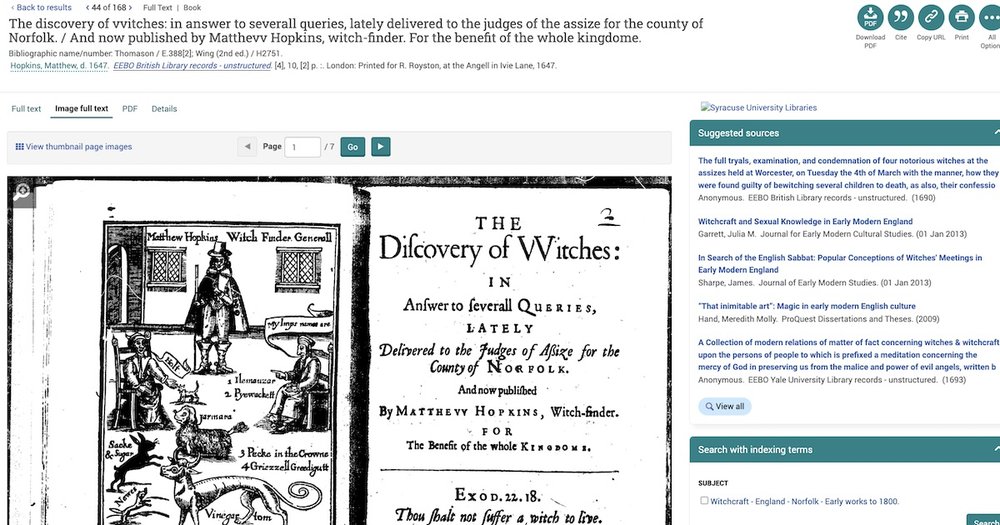
Syracuse University Libraries have supported research in early printed books and Early Modern culture for several generations now, and our primary collection of digitized early modern books in English has received a significant upgrade over the past couple of years. Early English Books Online (EEBO), which houses text and page-image scans from nearly 150,000 titles in literature, history, philosophy, linguistics, theology, music, fine arts, education, mathematics and science, is an essential tool for those interested in the period. EEBO has its roots in Pollard & Redgrave’s Short-Title Catalogue (1475-1640) and Wing's Short-Title Catalogue (1641-1700) and their related catalogs and revised editions, which document early books printed in English located in the collections of the world’s major libraries. Eugene Power, who founded University Microfilm International (later to become ProQuest), undertook a project in the late 1930s to photograph as many of those texts as possible to preserve access in response to the rising conflict and uncertainty of the era. Originally distributed to libraries through a microfilm subscription, the Early English Books material became a valuable tool to explore and reference Early Modern texts for researchers not able to visit libraries to view the texts themselves. With the advent of digitization in the 90s, the collection was scanned for access via CD-ROM, and eventually an online database resembling what we have today that has been a site of upgrade and innovation for the past three decades.
In its current form, EEBO offers researchers deep indexing for 146,000+ titles in the collection, with full searchable hand-keyed text access (more on that in a moment) to over 60,000 of those titles so far. Users can search for keywords, browse illustrations and other document features, and navigate the collection via subject headings and name authorities to unlock hundreds of years’ worth of content from their computers. Recent enhancements to the platform include the incorporation of USTC Subject Headings, which frame the texts with contemporary research topics in mind, and a sophisticated treatment of spelling variants and helpful searching and browsing interface features mapped to the complexity of these special texts.
Due to the nature of early printed texts and their images, typical optical character recognition (OCR) techniques employed to convert images of text to full-text transcripts cannot be reliably employed on the EEBO page images, and that difficulty led to the EEBO Text Creation Partnership (TCP), a consortia project of ProQuest with many libraries (including Syracuse University Libraries) to fund and support high-quality transcription, XML preparation and wider access to the text of the books contained in EEBO. Since 1999, the TCP has made over 70,000 titles (most of them from EEBO) available in full text for searching and research. EEBO TCP serves as a full text subset of the material that connects to ProQuest indexing to enable research across both platforms.
If you are interested in learning more about the history of EEBO, the article cited below tells the story of the digitization process. The Folger Shakespeare Library also offers a timeline and explanation of the process on its Folgerpedia site.
Mak, Bonnie. “Archaeology of a Digitization.” Journal of the Association for Information Science and Technology, vol. 65, no. 8, 2014, pp. 1515–26.
To provide feedback or suggest a title to add to the collection, please complete the Resource Feedback Form.