
SCRC Engaged with Central New York Humanities Corridor Working Groups
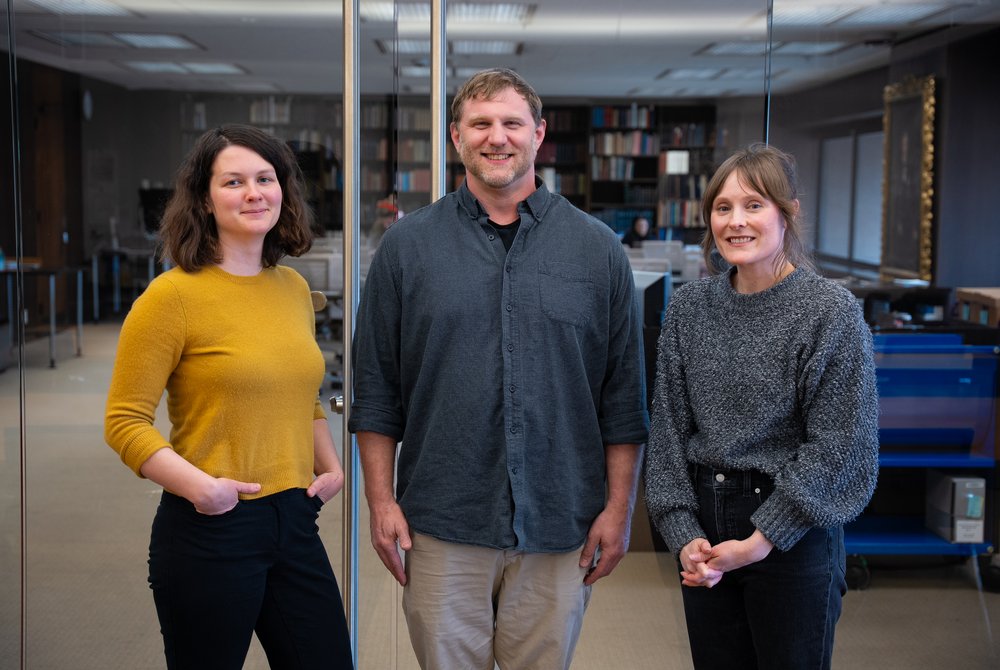
Irina Savinetskaya, Curator, Brett Barrie, Catalog Librarian, and Jana Rosinski, SCRC Instruction and Education Librarian, help organize three current CNY Humanities Corridor working groups.
Special Collections Research Center (SCRC) staff are directly involved as organizers for three current Central New York Humanities Corridor working groups:
- Brett Barrie, Catalog Librarian, AM10: AI, Archives and Museums,
- Irina Savinetskaya, Curator, HF8: Curating the Middle Ages, and
- Jana Rosinski, SCRC Instruction and Education Librarian, HF14: Primary Praxis: Experiential Humanities Research in Special Collections and Archives
AM10: Exploring AI in Archives and Museums
This is a collaborative working group bringing together library and information professionals from Upstate New York. Brett Barrie attended all their events last year before joining the group and found it to be a welcoming, entry-level forum for anyone curious about how artificial intelligence (AI) is shaping the world of special collections, archives and museums. From text transcription and image analysis to deep learning and pattern recognition, AM10 explores a wide range of AI functions with a focus on practical implementations in the humanities and a critical eye toward the ethical questions these tools raise. The lectures provide context for how peer institutions are assessing and implementing AI tools, in addition to asking larger questions about how library, archive and information professionals should approach this transition.
The group is hosting an upcoming event on April 17th at Rochester Institute of Technology’s (RIT) Alumni House from 10AM-1PM. Anyone interested can register to attend. Joshua Finnell and Joe Donnelly of Colgate University will share their rubric for evaluating AI research assistants using JSTOR Seeklight as an example. Following their presentation, Brett Barrie will facilitate a round-robin discussion about AI tools currently being used in the field. Barrie said, “I’m looking forward to questions and personal examples, hearing how others are navigating the evolving landscape within their own libraries.” The event culminates with the 12PM hybrid keynote “Ethical AI in GLAM” by Dr. Angela Fritz of the University of Iowa, a leading voice on ethical AI in galleries, libraries, archives, and museums (GLAM), and author of AI and Digital Leadership: Transforming Libraries, Archives, and Museums for the Future. For those just starting to explore AI to those already experimenting with it in their institution, this gathering is a fantastic opportunity to learn, share and connect. The event is generously supported by the University of Rochester, RIT's Museum Studies Program and the Wehrheim Endowment at RIT.
HF8: Curating the Middle Ages
In 2022, Irina Savinetskaya, Curator of Early to Pre-20th Century at the SCRC, co-founded this working group with Anna Siebach-Larsen (University of Rochester) and Juilee Decker (Rochester Institute of Technology). The group brings together GLAM (Gallery, Libraries, Archives, and Museums) professionals from Central and Western New York to develop strategies for making medieval collections more diverse and accessible. Through grant funding, it has brought an impressive roster of scholars and practitioners to the region, including Lisa Fagin Davis (Executive Director, Medieval Academy of America), Dot Porter (Curator of Digital Research Services, University of Pennsylvania), C.J. Jones (Robert M. Conway Director of the Medieval Institute, Notre Dame University), Sara Poor (Associate Professor, Princeton University), and Christopher Foster (Librarian, China Section, Asian and Middle Eastern Division, Library of Congress). The group has also organized public tours of special collections across member campuses and hands-on engagement sessions focused on the imaging, preservation and making of medieval manuscripts.
For Dr. Savinetskaya, the work has been as much about community as scholarship. "The most rewarding part of this collaboration has been getting together with scholars from nearby institutions and engaging with the pressing questions of our field alongside curators, librarians, archivists, faculty, students and the wider public," she reflects. The group has also served as a catalyst for collaborations that extend beyond Corridor-funded events. In April 2023, for example, Dr. Decker and the Multispectral Imaging in the Humanities and Arts (MISHA) team spent a day at Syracuse University imaging SCRC materials, consulting with faculty and staff, and offering a public multispectral imaging demonstration that drew audiences from across the university and wider community. Two years later, some of the multispectral images taken that day of Syracuse University’s MS 47, a medieval palimpsest codex, were featured in the spring 2025 SCRC exhibition "The Making of the Medieval Book."
HF14: Primary Praxis: Experiential Humanities Research in Special Collections and Archives
This working group was co-founded in 2025 by Jana Rosinski, Instruction and Education Librarian, Courtney Hicks, former Lead Curator and Curator of Plastics and Historical Artifacts, and Emily Beran, Research and Instruction Librarian for Rare Books and Manuscript Collections at Cornell University. The working group, which aims to bring together professionals across the corridor institutions in libraries, archives and special collections in a community of praxis, is geared toward those who support education initiatives rooted in primary source engagement. Just finishing its first year, they’ve created programming centered around the shared wisdom and expertise of Robin M. Katz, archivist, librarian and primary source educator, and Hannah Alpert-Abrams, a justice-oriented worker dedicated to education, cultural heritage and public knowledge.
The humanities have come to be a space that transcends disciplinarity, bringing together individuals from disparate backgrounds of lived experience, knowledges, perspectives and ways of making meaning, who seek to create responsive scholarship that affects/effects the world we all live within. Central to the humanities are the spaces of libraries, archives, special collections and museums—sites that bring people together and in critical conversation with our human experience in all its complexity. As information practitioners, cultural heritage stewards and humanist educators, connecting the public with the primary source material traces of history is a democratizing process that empowers individuals. Such creative and critical engagement fosters historical empathy and leads to greater understanding and more representative tellings of our human narrative(s). This working group aims to build self-reflective, critical and forward-thinking approaches and strategies in bringing a more diverse set of perspectives to the conversation of what primary sources mean to humanity’s past, present and future.