
The Syracuse University College of Medicine’s Architectural Legacy
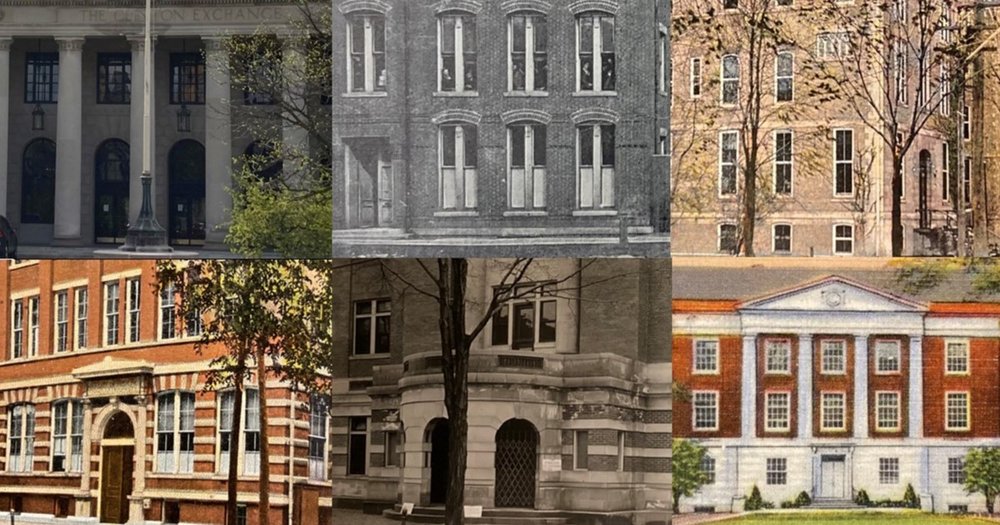
by Anna E. Shuff G’26 (School of Information Studies), University Archives
This semester, I processed the Syracuse University College of Medicine Records for the University Archives. The College of Medicine operated at Syracuse University from 1872 to 1950, when it was transferred to the State University of New York system to found SUNY Upstate Medical University. Although it hasn’t been part of SU for over 75 years, it lives on in the architecture on and around campus.
Clinton Block
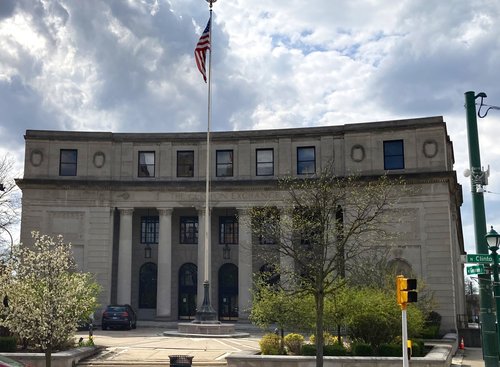
The Clinton Exchange Building, built in 1928 as a post office and federal building, sits on the site formerly occupied by Clinton Block.
Syracuse University’s College of Medicine has its origins in Geneva Medical College, which was part of what is now Hobart and William Smith College. In 1871, the Medical College closed and the medical library and museum were transferred to Syracuse University on the condition that SU would immediately found a medical school.
The College of Physicians and Surgeons at Syracuse University (later the Syracuse University College of Medicine) held its first classes in 1872 in rented rooms in Clinton Block, which sat on the site of what is now the Clinton Exchange Building near Clinton Square in downtown Syracuse.
First College of Medicine Building
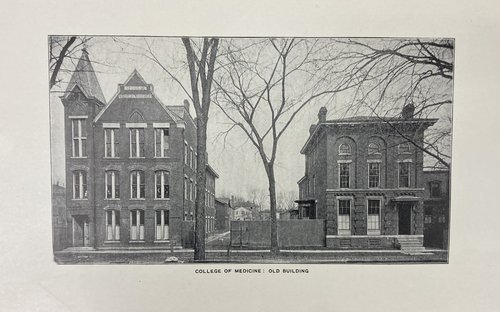
The College of Medicine’s first two buildings as they appeared prior to their demolition in the 1890s. The buildings were originally a carriage factory (left) and a blacksmith’s shop (right).
The College of Medicine got its own building in 1875 when the College’s faculty purchased a former carriage factory on what is now McBride Street and renovated it to accommodate the needs of a medical school. An outbuilding that previously housed a blacksmith’s shop was converted to laboratory facilities.
Following the construction of a new College of Medicine building in 1896, the structures were demolished.
Hospital of the Good Shepherd
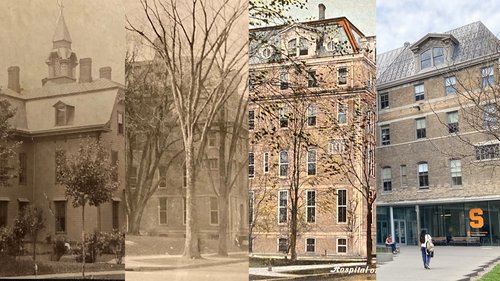
The Hospital of the Good Shepherd/Huntington Hall over time. From left to right: The Hospital of the Good Shepherd’s original wooden building circa 1880-1890, the Hospital’s renovated stone building circa the 1910s, a picture postcard of the Hospital from 1913, and Huntington Hall as it appears today.
The Hospital of the Good Shepherd was founded in 1873 and partnered with the College of Medicine early in its history to provide clinical training for students. The Hospital building was constructed on University Avenue in 1875 and was expanded and renovated throughout the following decades. Facing financial issues, the administration of the Hospital was transferred to Syracuse University in 1915. It was operated by the University even after the College of Medicine was transferred to the SUNY system. It closed in 1965, after the opening of the State University Hospital (now Upstate University Hospital).
The building was renamed Huntington Hall in 1964 and was repurposed for academic use. Today, it is home to the Syracuse University School of Education.
Second College of Medicine Building
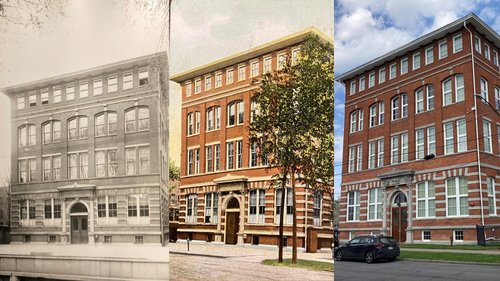
The College of Medicine’s second building, now called Peck Hall, appeared over time. From left to right: The College of Medicine building circa the 1910s, a color postcard of the College from 1916, and Peck Hall as it appears today.
In 1896, Syracuse University constructed a new College of Medicine Building to replace its original facilities, which had become cramped and outdated. The new building was a state-of-the-art facility for the time, with laboratories, classrooms and a cold storage facility in the basement to preserve medical specimens.
Eventually, the College of Medicine outgrew this new building as well, and in 1937 it was handed over to the School of Extension Teaching and Adult Education (now the College of Professional Studies). In 1958, the building was rededicated as Peck Hall and is now home to Syracuse University’s Couple and Family Therapy Center.
Syracuse Free Dispensary
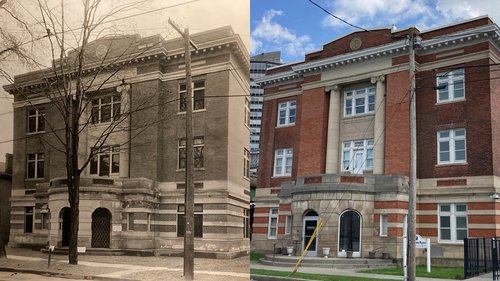
The Syracuse Free Dispensary/Reid Hall circa the 1920s, and how it appears today.
The Syracuse Free Dispensary was a public outpatient clinic operated by the College of Medicine that provided healthcare to low-income Syracuse residents. Founded in 1888, it allowed medical students to get hands-on clinical experience. In 1914 the University completed construction on a new, modern Dispensary building located just north of the second College of Medicine Building (now Peck Hall).
The Dispensary operated in this location until 1954. In 1957 Syracuse University renovated the building for use by University College, rededicating it as Reid Hall the following year. The building now houses SUNY Upstate Medical University’s McMahon/Ryan Child Advocacy Center.
Third College of Medicine Building
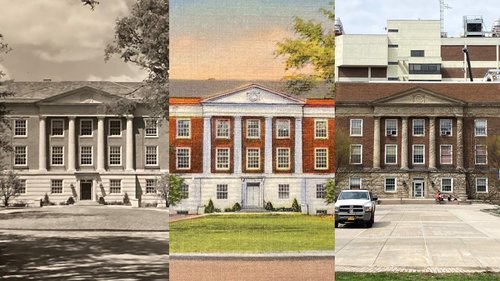
The third College of Medicine Building/Weiskotten Hall as it has appeared over time. From left to right: The third College of Medicine building circa 1937, a pre-1950 color postcard of the College of Medicine building, and Weiskotten Hall as it appears today.
By the 1930s, the College of Medicine was once again in need of new facilities. However, with the country in the throes of the Great Depression, the University did not have sufficient funds for such a project. In 1935, the University successfully applied for an $825,000 loan from the federal Public Works Administration, and in 1936 President Franklin Delano Roosevelt laid the cornerstone for the new College of Medicine building. The structure was completed in 1937 and remained the home of the College of Medicine until its transfer to the SUNY system in 1950.
The building was renamed Weiskotten Hall and remains part of SUNY Upstate Medical University’s academic facilities to this day. It houses classrooms, offices, laboratories, and the school’s Health Sciences Library and Archives and Special Collections department.