
Cube Game: The Rubik's Cube and Other Dimensional Puzzle Games
Page featured image content
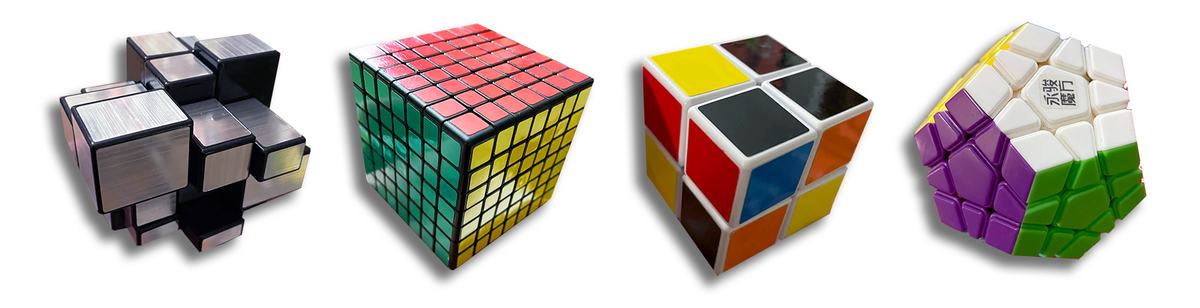
Page main body content
November 2-30, 2026
Hungarian Architect and professor of design Ernő Rubik invented the cube in 1974, following his interest in three-dimensional geometry and the relationship between dimensional shapes. Originally known as the Magic Cube, it was rebranded as the Rubik’s Cube upon its worldwide release in 1980, quickly becoming the trendy must-have novelty of the decade. By the early 1980s, millions were attempting to solve its not-so simple challenge: arranging six faces of colored squares so that each displayed a single color. The Cube’s breakout success generated an entire industry of related products. Variations on the original design appeared in numerous shapes, sizes and configurations, while other mechanical puzzles, including Rubik’s Snake, offered unique ways to manipulate geometric forms. Competing manufacturers introduced their own puzzles, with unauthorized copies and imitations becoming commonplace. The Cube also inspired board games, card games, promotional merchandise and an extensive assortment of instructional books promising to reveal the secrets of solving it for a meager sum. Its influence extended well beyond the toy industry. The Cube became a fixture of popular culture, appearing in television programs, films, advertisements, cartoons and comics. Closely associated with the 1980s, it has become a visual symbol of the decade. For some, solving the Cube became an obsessive pastime. Speedcubing developed into a highly competitive international sport, with hopefuls refining techniques to solve the complex puzzles in shorter and shorter times. Advances in technology brought robotic systems into the competition, showing that a handheld toy may serve as a serious challenge in mathematics, engineering and computer science. This exhibition explores the Rubik’s Cube as both a puzzle and cultural phenomenon, tracing its development, commercial success, numerous offshoots and continuing influence. From early examples and instructional guides to unusual variations and contemporary speedcubing, the objects presented here illustrate how a deceptively simple invention became a lasting part of popular culture. Few toys are as culturally iconic yet intellectually frustrating as the Rubik’s Cube.
Curated by Stephen Singer and Abigail Traska.
Game On!: Titles from the Bird Library Board Game Collection
Featured in the Miron case.
What do the Sheriff of Nottingham, the pandemic and exploding kittens have in common? They're all subjects of board and card games from Bird Library's game collection, located in the first-floor Learning Commons. Whether you're looking to do a puzzle, topple a Jenga tower or take a Risk, we have them all, free to borrow!