Creativity in Translation

by Catherine C. Cocks, Director, Syracuse University Press
For thirty years, SU Press has published English translations of contemporary and classic literature from the Middle East and North Africa. To celebrate this milestone and the visit of one of our author-translator pairs to campus, we’re gathering thirty of the more than ninety titles we’ve issued since 1996 in a special display at Bird Library this month. We hope you’ll check them out, literally—take one (or a few!) home with you to read.
SU Press’s Middle East Literature in Translation series is one of a kind in its linguistic and geographic range. Recognizing the diversity of the Middle East and North Africa, we’ve published works originally issued in Arabic, Turkish and Persian, of course, and also Uzbek, Urdu and Kyrgyz. The series includes books first written in Hungarian and French, too, because the authors had roots in the Middle East and are contributing to its vibrant literary tradition. The variety of languages showcases the complex transnationality of a region that has long been at the heart of global geopolitics and of far-flung diasporic communities.
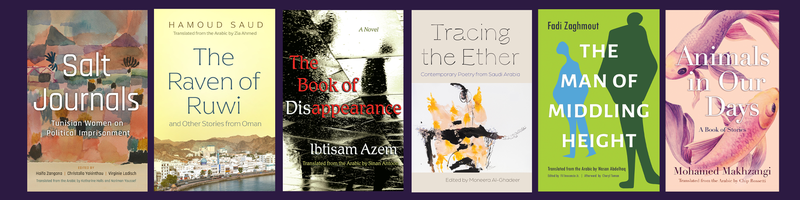
The Middle East Literature in Translation series also stands out for its emphasis on twentieth- and twenty-first century works of all genres—novels, poetry, short stories and essays. To give just a few examples, Tracing the Ether gathers work by twenty-six contemporary Saudi poets striving to understand our increasingly digital world. Fadi Zaghmout’s The Man of Middling Height imagines a world in which your height determines who you are supposed to have sex with. Shortlisted for the Arabic Booker Prize in 2010, Mohamed Mansi Qandil’s A Cloudy Day on the Western Shore tells the story of a young Egyptian woman’s involvement in the British excavation of the pyramids in the early twentieth century, raising questions of colonialism, gender and sectarianism. The House of the Edrisis, by the major twentieth-century Iranian novelist, Ghazaleh Alizadeh, deploys black comedy and farce in telling the tale of a once-affluent aristocratic family grappling with the consequences of an unnamed revolution.
In addition to these contemporary works, we have some outstanding classics, like Ahmet Mithat Efendi’s Felâtun Bey and Râkim Efendi. First published in 1875 in Turkish, it is a canonical tale of two young men in the modernizing Ottoman Empire. Another classic is Turkey, Egypt, and Syria: A Travelogue, in which the prominent Indian intellectual and scholar Shibli Nu‘mani (1857–1914) narrates his journey across the Ottoman Empire and Egypt in 1892.
There’s much more to the series than just the thirty wonderful books currently on display at Bird. Please check out the full Middle East Literature in Translation list on the SU Press website. New translations are already in production at the Press, and we’re always looking for great stories that may have been overlooked.
If you’d like to meet one of our authors and her translator, you are in luck—Ibtisam Azem and Sinan Antoon are coming to Syracuse University on March 26 for a workshop and reading centered on The Book of Disappearance, longlisted for the International Booker Prize in 2025. Hosted by SU’s own Sevinç Türkkan (Writing Studies, Rhetoric, and Composition), Azem and Antoon will discuss the process of translating The Book of Disappearance from Arabic into English. Because every language offers its speakers unique ways of expressing themselves, translating from one to another requires intimate knowledge of both and creativity in bridging the gaps between them.
The “Creativity in Translation” workshop and reading were made possible by generous support from the Humanities Center, as part of its symposium on creativity. We also gratefully acknowledge additional support from the English Department, the Writing Studies, Rhetoric, and Composition Department, the Department of Languages, Literatures, and Linguistics, and the SU Libraries.