
Getting into the Groove: A Student’s Perspective on Audio Preservation
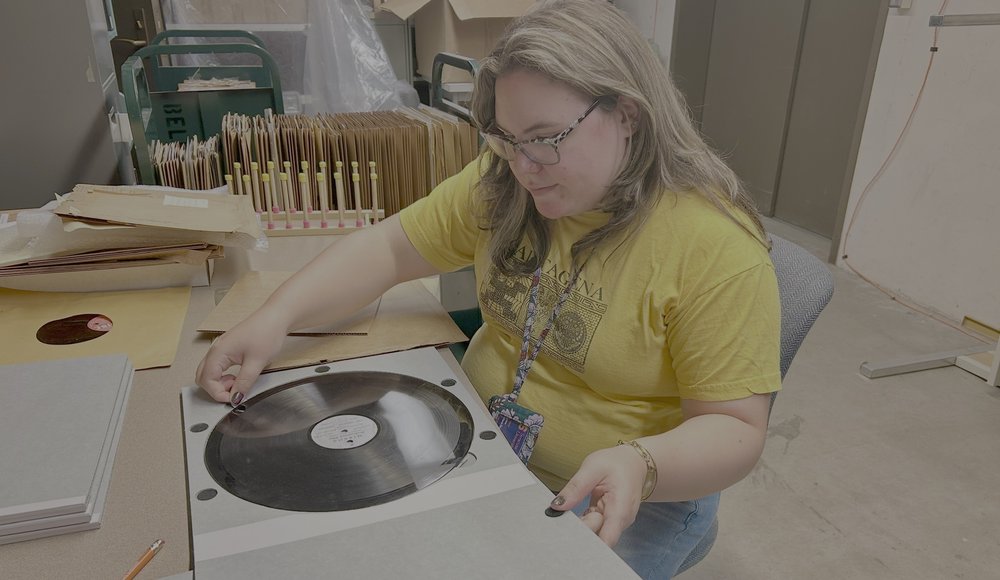
by Lyann Lallave Segui G’25, School of Information Studies, and former Media Preservation Student Assistant
Audio in all its forms has always been an important part of my life and a passion of mine. Prior to my studies in the School of Information Studies, I collected, catalogued and researched for my own vinyl collection; in a way those interests are what drove me to pursue the Lacquer Disc project. I began this project with no prior archival experience, which is important to highlight. Although this project is very specialized and requires specific handling and processing knowledge, I was able to learn these skills with the guidance of Media Preservation Archivist, Ivayla Roleva-Peneva. In archives, processing is the organization, description and rehousing of items in archival collections to preserve their physical integrity and the information stored within the items. Whether the item is a photograph, document or audio/audio visual materials, each distinct material type requires unique sets of storage and handling requirements.
The Lacquer Disc project collaboration began in early 2024, featuring staff from both the Special Collections Research Center (SCRC) and the Department of Digital Stewardship (DDS). We started on the pilot project working with the Lewis Krasner Papers. Krasner was a former Syracuse University Professor and renowned violinist; his collection contained a little over 200 lacquer discs which covered Syracuse University musical performances from the 1950s along with personal recordings. While working on Krasner, I learned proper handling techniques for lacquer discs, which have unique requirements compared to other media types. Because of their fragile nature and their age, it is important to handle the discs carefully and keep in mind that any sort of movement or change could result in further degradation. A key part of deterring degradation is keeping hands clean to avoid skin oils adhering to the discs and holding discs in the proper manner by avoiding touching the grooves. I would often consult the Association for Recorded Sound Collections (ARSC) Guide to Preservation when I had questions regarding proper care of the lacquer discs or ask Iva questions. Part of the handling process included identifying different types of damage that affected the discs and recording this information in Physmedia, the database where SCRC keeps individual item records and collection details. I became familiar with the most common types of damage that affect lacquer discs. Waxy exudate/palmitic acid was the most common type of degradation recorded and is a type of white powdery substance that the lacquer discs produce as they begin to break down over time. Crazing, peeling lacquer and cracking are all similar forms of damage where the lacquer separates from the disc’s base and can no longer be digitized since the material is unstable. Crazing is when there are small lines where you can see the disc base peeking through the lacquer as it starts to crack and separate. I also learned how to properly identify different types of lacquer discs since there are a variety of base types, and it is important to identify this information when entering metadata into Physmedia.
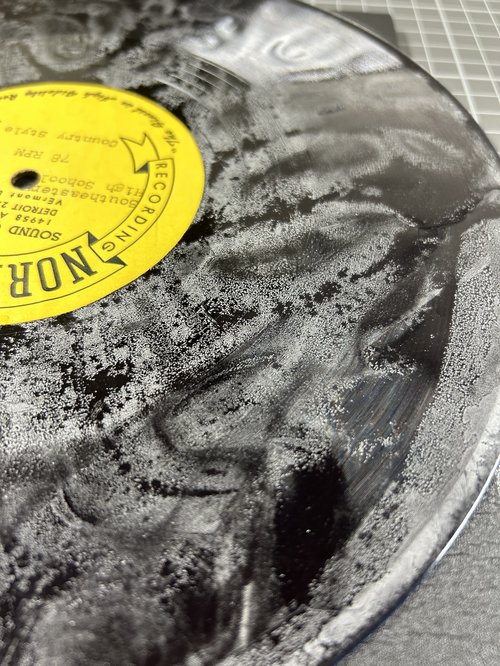
A lacquer disc from the Marie Joy Curtiss Papers with heavy palmitic acid exudation—the leeching out of chemicals that have been used in the creation of the nitrocellulose lacquer coating of the disc.
This project provided me with the basic skills that I used for the rest of my time processing the lacquer discs and working on various collections. With this knowledge I was able to work with collections that were at varying stages of degradation. Some were in good condition like those in the Marie Joy Curtiss Papers, while others were completely shattered or had lacquer peeled off the disc like various discs in the Donald J. McCann Papers. Understanding the unique requirements for the media and taking time to handle and properly care for the discs and treating the items appropriately along with any additional ephemera that might accompany the items is an important part of this position. While processing the discs, I would come across various papers or pieces of ephemera attached to the disc or sleeves that housed them. Many of these papers were in delicate condition and required extra care to handle to ensure proper preservation of any information. Often notes, newspaper scraps or old sleeves would provide essential information or clues that would aid in the description process while entering metadata. Proper documentation of these items and storage with their respective discs is important to ensure that discs do not lose these invaluable pieces.
All these skills facilitated my transition from processing media to cleaning the discs once I started working with Audio Preservation Engineer Jim Meade over the summer. I was able to properly handle discs, understand which discs were in good condition to clean and which ones would be unstable because of damage. I found that it was important to keep an eye on small details, especially during the cleaning process. Watching out for chips, hairline cracks, peeling and any other damage is crucial to prevent further damage during the cleaning process. Understanding different levels of exudation on discs helps determine what type of cleaning solution to use when applying them to the discs.
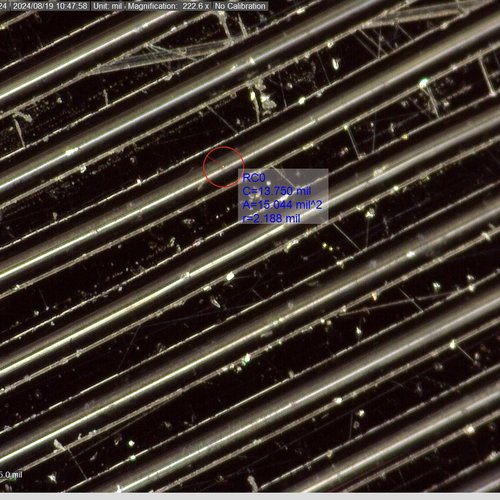
Image of the lacquer disc grooves as seen through a microscope, radius measurement taken from center of groove to the edge.
Another way in which understanding the media aided in working on my other tasks was being able to measure grooves appropriately. By knowing how lacquer discs and other grooved media worked, I was able to use my knowledge to appropriately measure groove sizes with the microscope and record this information for Jim. By being able to measure the radius of the disc groove, the appropriate playback needle can be selected based on the size of the groove. This information makes playing back discs and digitizing the audio easier and removes guesswork that may slow down the process or risk damaging the disc.
Lastly, the final thing that aided my work with these lacquer discs is my research background and investigative skills. While processing the lacquer discs, many times I would come across names, places and songs which I was unfamiliar with and would require further investigation to determine what the subject or performance could have been. This is especially important when identifying Authority Names using the Library of Congress Authority Name File. Trial and error and using different spellings or different last names, combinations of names, and searching by date of birth and date of death are all crucial for obtaining the appropriate Authority Name for our metadata records. Documenting research is also an important skill, which is something I began to do in my last project and found helpful for both SCRC and DDS. By leaving detailed notes on my research process, I helped provide information for identifying audio during digitization, and I left a record for others to reference in the future. My notes will continue to help improve the processing quality in the Belfer Audio Archives in the future and aid other student workers who may take over the work after I am gone.
Overall, my time working on this project provided me with many beneficial skills and a unique experience which I can reflect on and apply to other projects in the future. It also gave me a new perspective on the role that archivists play regarding preservation and the temporary nature of certain media types like lacquer discs. Because of my work on this project, I now enjoy educating others on the topic of audio digitization and the importance of preserving at-risk media. I hope to continue to educate and share my experiences with others as an information professional.