
Lacquer Disc Preservation Project: Development and Progress
by Ivayla Roleva-Peneva, SCRC Media Preservation Archivist
Part One: Behind the Project with the Media Preservation Archivist
This will be a two-part post from SCRC’s Media Preservation Archivist and the former graduate student media assistant about their roles in developing the Lacquer Disc Preservation Project between the Special Collections Research Center and the Department of Digital Stewardship here at Syracuse University Libraries.
The (De)Composition of Lacquer Discs
In 2023, what began as a project idea quickly developed into a collaborative in-house preservation effort between Jim Meade, Senior Audio Preservation Engineer in the Department of Digital Stewardship (DDS), and me, Ivayla (Iva) Roleva-Peneva, Media Preservation Archivist at the Special Collections Research Center (SCRC). Together, we presented evidence to our departments, emphasizing the urgent need to prioritize preservation of one of the most vulnerable audio recording formats, the lacquer discs, before they become completely unplayable.
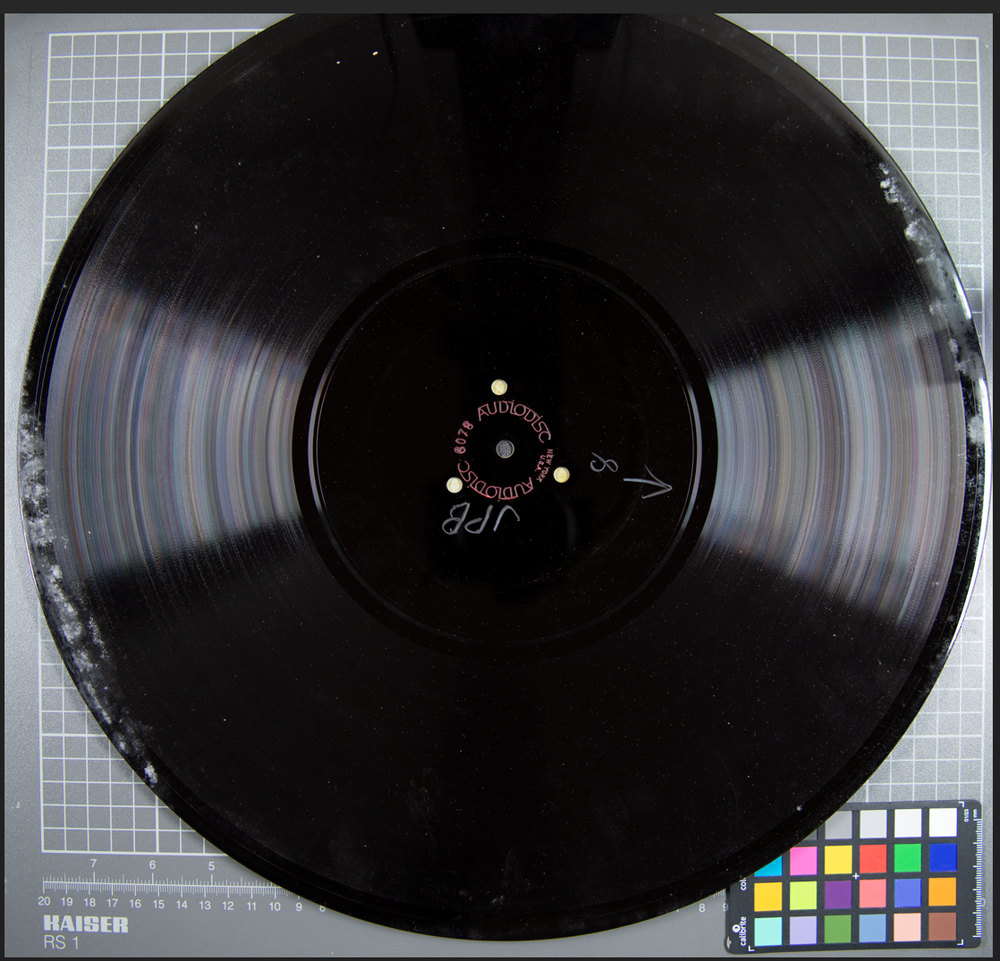
Lacquer, also known as transcription, instantaneous, direct-cut or “acetate” disc, is a grooved disc format composed of different material layers. The base of the disc was primarily aluminum, but it can also be steel, glass or cardboard, coated with either cellulose nitrate or cellulose acetate lacquer, plasticized with castor oil or camphor. Cutting equipment was used to cut grooves directly into the lacquer layer of a blank disc. The lacquer discs were sturdy enough to sustain several playbacks. This audio format was produced in various sizes, including 7, 8, 10, 12 and 16 inches in diameter, with inside or outside-start, with lateral or vertical-cut grooves and playback speeds of 33 1 ⁄ 3 or 78 rpm (rotations per minute). Record size and playback speeds correspond to how much audio information can be stored on a record.
Lacquer discs were produced from the late 1920s and continued to be used as late as 1970. They were primarily used for recording live radio broadcasts, home recordings, field recordings and even “audio letters.” Many of these discs contain unique, original content. Others are rare copies of recordings, with only a limited number in existence. In archival collections, there are also numerous duplicates of widely available commercial recordings. The only way to determine the generation of these discs is by listening to them during the digitization process.
Unfortunately, due to its nature, the lacquer disc media format is inevitably deteriorating, especially when stored in “unhealthy” humid environments with high or fluctuating temperatures. Over time, the coated material reacts with moisture and oxygen in the air, resulting in the loss of plasticizers, while the base remains the same size, which results in shrinkage, cracking and crazing of the playback surface. This degradation leads to the irreversible loss of the audio recording.
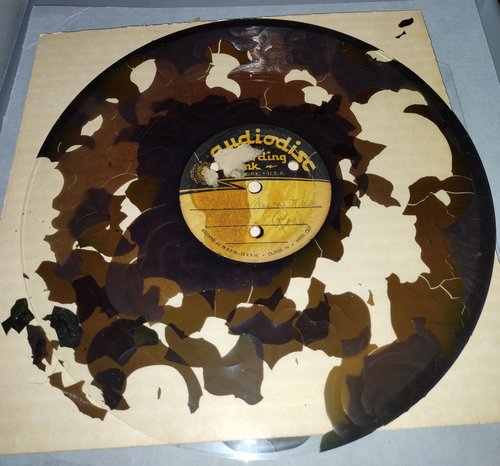
Severely delaminated and unplayable lacquer disc with glass base.
Although lacquer discs make up only a small fraction of the SCRC's audiovisual holdings —about 3% of nearly half a million items — they still represent a significant amount, totaling close to 10,000 records. Considering the high risk of media degradation, the lack of comprehensive inventories of the collections, the volume of unprocessed lacquer discs sitting in boxes or on storage shelves, the amount of processing time needed and the limited number of skilled professionals in the Syracuse University Libraries, Jim Meade and I developed a project proposal focused on the preservation of the lacquer discs. Our proposal received strong support from both the SCRC and DDS units. DDS generously offered to fund a graduate student position to assist with our efforts. A key highlight of this unique opportunity is the experiential learning aspect for students passionate about audio recording preservation.
Project Beginnings
In January 2024, we officially launched our project and formed a team consisting of three members: Jim, myself and a graduate student media assistant, with each of us assigned a specific set of tasks. For our pilot project, we selected the Louis Krasner Papers collection. During the implementation phase, our predictions and expectations were largely confirmed, enabling us to apply the systematic approach we developed to the digitization processes of any future lacquer disc projects. By the end of 2024, we had tackled and successfully digitized over 500 discs from 19 different collections. In 2025, we focused primarily on preserving a larger collection with more than 1,600 lacquer discs.
Since the project began, each of us has been focused on our assigned tasks, and we have held regular meetings to discuss project developments, challenges, suggestions for improvement, research outcomes, interesting encounters and more.
Roles and Responsibilities: The Media Preservation Archivist
My responsibilities include overseeing various administrative tasks, such as:
- Compiling a master list of all collections with lacquer discs, which serves for project planning.
- Communicating with the appropriate stakeholders regarding the selected projects. As caretakers of special collections, there are always materials in need of particular attention. Sometimes we prioritize certain collections over others based on pressing material needs; this means other materials are “on pause” as our time and attention is directed at the more urgent material needs.
- Coordinating the delivery of the chosen collections to the SCRC location for processing.
- Updating the collections database accordingly and editing the collections’ finding aids. These are areas of important information both internally to SCRC staff about the materials, but also the public-facing documentation that informs and guides researchers utilizing our collections.
- Reviewing the pre-digitization and post-digitization project workflows to ensure the steps we designed encompassed everything that needed to be done and documented for continuing this work.
- Facilitating communication, meetings and reports between the SCRC and DDS. Even though we work within the Libraries’ and with the same collection materials, we’re distinct units in different spaces.
Roles and Responsibilities: The Graduate Student Media Assistant
In general, the Lacquer Disc Preservation Project processing has three main stages: Pre-Digitization, Preservation and Post-Digitization processing. During the 2024-2025 academic year, the graduate student media assistant was responsible for both pre-digitalization and post-digitalization processing of media. The pre-digitization steps include:
- Creating item-level descriptive metadata in the SCRC database in compliance with local archival standards and best practices.
- Identifying media formats and processing the items. Processing encompasses the activities that archivists do with materials we receive: arranging, inventorying, describing and performing acts of preservation so the materials will be ready for archival storage and researcher use.
- Evaluating the condition of the discs and estimating preservation needs.
- Proper handling and rehousing of the lacquer discs.
Before handling the inventoried discs for audio preservation, the graduate student media assistant was also helping with preparing discs for digitization, which includes the following:
- Using a microscope to measure the disc’s grooves.
- Photographing the discs and their accompanying materials, such as notes, newspaper clippings, etc.
- Utilizing disc cleaning equipment to clean the various-sized discs with an appropriate chemical solution.
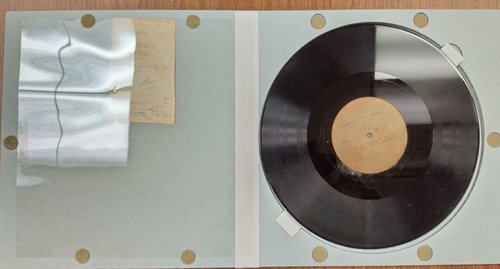
Delaminating lacquer disc accompanied by ephemera content note, rehoused in a custom-made portfolio, designed by David Stokoe, SCRC Conservation Librarian.
Roles and Responsibilities: The Audio Preservation Engineer
Jim, as Audio Preservation Engineer, holds a critical role in the whole audio preservation process at the SU Libraries. With his professional expertise and extensive background, he is the only person capable of conducting the digital transfers to bring the audio recordings back to life. During the Preservation phase, Jim performs the following tasks:
- Carefully examines each disc and approves or rejects discs for the wet cleaning process based on condition.
- Transfers the audio discs.
- Verifies the accuracy of the existing metadata, or conducts further research as needed to establish the correct metadata. Metadata about a collection item helps us internally in having accurate information about an item for the many ways our collections are utilized. Metadata is also what helps make our collections discoverable to researchers.
- Compiles a spreadsheet with metadata notes, used for post-digitization review.
- Discs unsuitable for playback with a stylus on a standard turntable are considered unplayable with in-house equipment and are slated for digitization with more sophisticated technology.
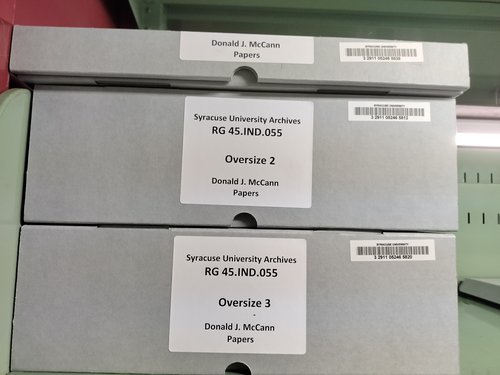
Three oversized boxes of the Donald J. McCann Papers containing multiple portfolios with damaged lacquer discs, housed flat in custom-made boxes designed by David Stokoe, SCRC Conservation Librarian.
Roles and Responsibilities: The Graduate Student Media Assistant
In the post-digitization stage, the graduate student media assistant worked again with the discs that had been digitized:
- Verifying and updating the item-record metadata based on the research notes gathered from Jim during the digitization phase.
- Boxing and preparing the completed discs for transportation to a SU Libraries' off-site climate-controlled storage facility, except for the fragile and damaged discs.
- Properly handling and rehousing damaged discs into custom-made portfolios and flat boxes.
Roles and Responsibilities for the Project’s Future
A year after launching the Lacquer Disc Preservation Project, our team reevaluated the graduate student responsibilities. We decided it would be more effective to divide these tasks between two students for future semesters. One student will assist during the pre-digitization and post-digitization phases, while the second student will focus on preparing, cleaning, and photographing the discs. So far, the results indicate that this change is working very well.
Part Two: Lyann’s Experience Working on the Project
Stay tuned for part-two, Getting into the Groove: A Student’s Perspective on Audio Preservation.