
How Our Lives Became Plastic: SOURCE Explore Students Research Material Culture in the Archives
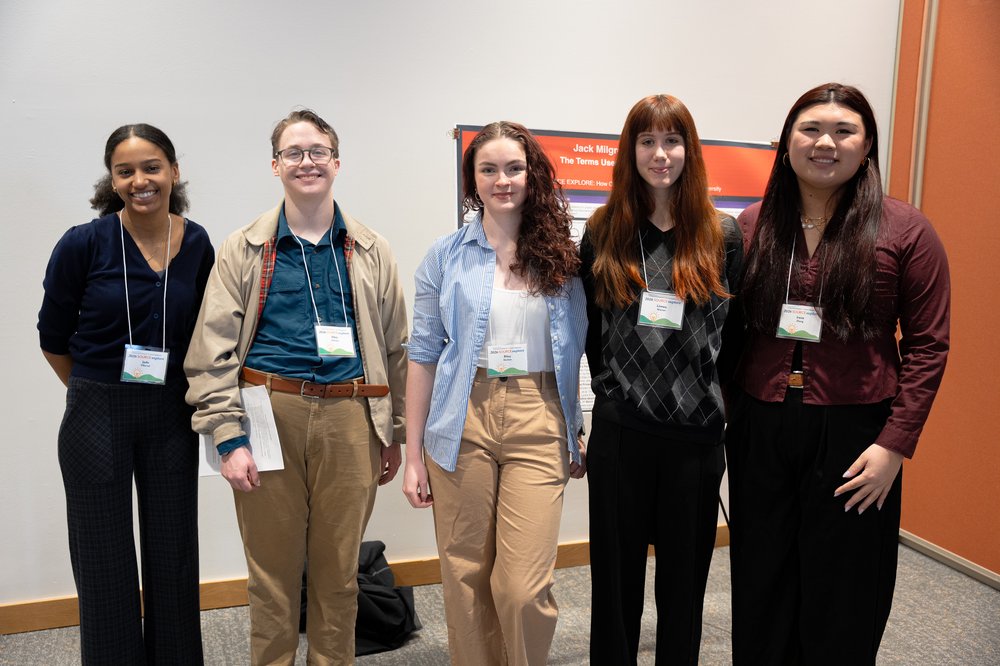
by Jana Rosinski, SCRC Instruction and Education Librarian
Here at SCRC, we introduce students to working with primary sources or materials that provide direct evidence or firsthand accounts of events, people and phenomena. These are rare or even one-of-a-kind items that can be accessed through the spaces and services of archives and special collections through our exhibitions and programming, and unique opportunities like class visits and the multi-week immersive research SOURCE Explore program. This spring’s SCRC cohort joined Courtney Hicks, Lead Curator and Curator of Plastics and Historical Artifacts, and Jana Rosinski, Instruction and Education Librarian, to explore something uniquely their own, bringing their experiences, interests and curiosities into conversation with historical materials from our Plastics Collection.
SCRC preserves and provides access to an array of primary sources including archival materials, books, periodicals, media and over 5,000 plastic artifacts produced from the mid-19th century to the present day that document the invention and development of plastic. The Plastics Collection is one of the most significant academic archival resources available for learning about histories of plastics and their vast intersections with human culture both past and future, as well as their impact on the world around us. It holds primary sources across a wide variety of formats, including prototypes, photographs, audio, film, advertisements, blueprints and more, all of which have the potential to support unique research within the expansive subject area of plastics.
Below is a brief overview of the students’ research projects in their own words, interspersed with photographs of them researching the Plastics Collection. The posters they presented on their work at the SOURCE Explore research fair were published to SURFACE, SU’s open access institutional repository.
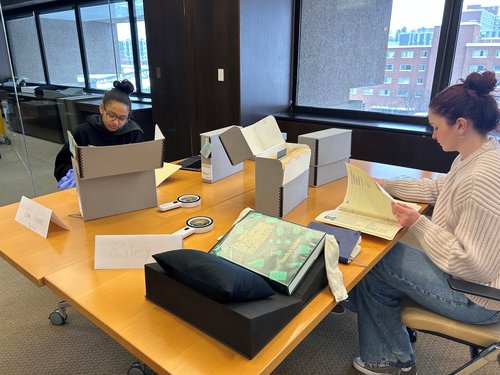
Jada Villaroel, left, and Riley Dechon, right, examine archival materials related to the Flexi-Disc audio format and the work of plastics consultant Jack Milgrom.
Riley Dechon, Jack Milgrom: A Case Study
Jack Milgrom was a plastics researcher and consultant, publishing reports on the marketability of plastics, packaging and recycling, several of which can be found in SU’s SCRC. Through Milgrom’s work, I ask how responsibility for plastic waste landed on the shoulders of consumers and not manufacturers during the peak of environmentalism. Milgrom’s reports offer a timeline as to how the plastics industry shifted its language and marketing methods to mirror the goals of environmentalism. By analyzing this shift against environmental writings of the time, which demonstrate an urgency to handle plastic waste, Milgrom reveals an awareness of what consumers want, but strategizes to capitalize off those wants, rather than aligning industry values with those of the current culture. Though Milgrom’s research and advising is decades old now, we can identify the strategies he recommended in the contemporary plastic industry.
Elliot Johnson, The Ways Plastic (Re)Shaped Labor Unions
In 1869, John W. Hyatt invented the first synthetic polymer. Since its invention, the many different forms of what we now call plastic have had extreme effects on life across the globe. In America, towns like Leominster, Massachusetts became epicenters for large-scale manufacturing, transforming a craft-based economy into an unskilled one. This project explores the ways in which, or indeed if, that transformation had profound effects on the laborers themselves, as well as their collective advocacy. This project also looked at the ways collective action took place in the 20th century, focusing specifically on the use of song. I analyzed George Friese’s union ephemera, most of which was from the Playthings, Jewelry & Novelty Workers International Union – CIO in Leominster, and a songbook published by the United Rubber Workers – CIO in 1954. I consulted a range of secondary sources to contextualize these artifacts. From there, I created a limited timeline comparing union activity and plastics industrialization to highlight correlations between the two. In Leominster, unions were not changed by plastics because their economy did not lend itself to collective action prior to the introduction of plastics. Plastics made room for unions by erasing the master/apprentice relationships that existed prior and introducing safety and compensation concerns. Because of the localized nature of labor and unions, it is hard to generalize this finding, which is why more research should be conducted on “plastic towns.” Despite the localization of unions, the songbook revealed that labor music transcended industry and region.
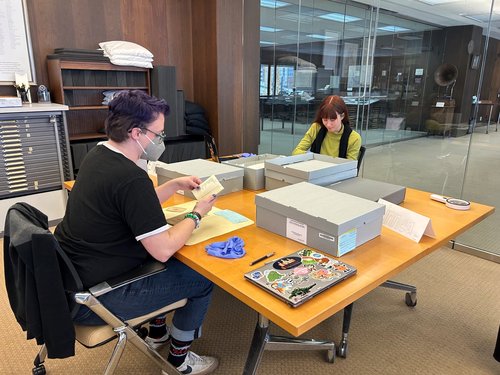
Elliot Johnson, left, looks at ephemera from workers in early plastics industry unions. Linnea Warren, right, looks at manufactured educational toys geared toward children.
Jada Villaroel, The Flexi Disc: A Brief History and Timeline of the Making and Distribution
The Flexi Disc, popular between the 1960s and 1990s, was an innovative product which brought decades of cheap music distribution to the homes of many Americans. Within the Plastic Artifacts Collection at Syracuse University are several flexi discs used as advertising, ranging from current musical artists to large food chains preserved in mailing envelopes from several decades of the 1900's. Observing these artifacts provided data and information to answer the question: how were flexi discs able to be manufactured at such low costs while maintaining a profitable market? Multiple sources, including physical flexi discs and chat logs, from the Special Collection Research Center were studied through a comparative lens to collect data on manufacturers, materials, dates and modes of advertising to answer the question stated. Information pertaining to the vinyl record, made with the same material as the flexi disc, was used to answer several questions regarding the manufacturing process while preserved packaging gave intel into the distribution aspect of the market. The material of the flexi disc, polyvinyl chloride, is a nonbiodegradable plastic left to circulate in natural environments leaving unknown impacts that may be further studied. Apart from the environmental impacts of the plastic materials used, a recent resurgence of physical media brings the question of whether flexi discs will ever make a return to manufacturers or if the market design is incompatible with the current economical state. The study of flexi discs dives into a music media outlet that is not heavily considered and inspects past and future relevance.
Linnea Warren, Evolving from Stereotype to Diversity
Dolls of Our World is a geography game from around the 1950s in SU’s Plastics Collection in which the player matches a doll to their flag based off outfit and short description. I wanted to know why Africa was not included, and overall, how geography games and teaching diversity have changed. I read several papers, including on plastic-color technology and the history of Black dolls. According to the categorization of “Gamification & Geography Education: A Survey & Typology of Games,” Dolls of Our World uses a storytelling narrative to teach, seen with the clothes and incorporation of people (however stereotyped). What I’m familiar with, the website Seterra, is location-based, with technical information such as maps and in comparison, is removed from the social element. While there is some argument to be made on injection molding color constraints (consistency vs customization), it is more likely that Black audiences were not prioritized. Shindana Toys, founded in 1968, was a groundbreaker for this, as their ethnically correct dolls (among the first) were quite popular, showing there was a profitable market. Teaching diversity has had a nonlinear path, with rare cases of seemingly modern global awareness as shown in the curriculum quote and given the instability of diversity education in the classroom today. There are still several questions pertaining to the Dolls themselves, such as references for their “native costumes.”
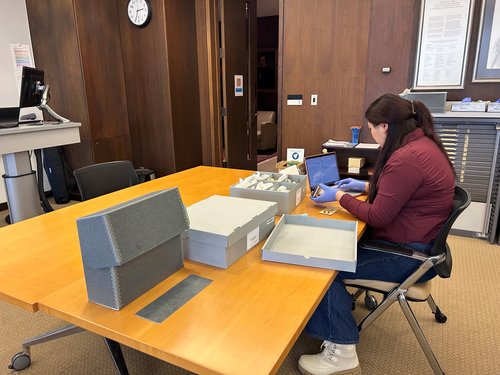
Irene Zheng analyzes mid-20th century artifacts related to pediatric medicine in the plastics collection.
Irene Zheng, Molding Childhood: Plastic’s Influence in Pediatric Care
Plastics emerged after World War II as a material associated with progress, cleanliness and possibility. In medicine, plastic replaced fragile glass tools and enabled inexpensive, standardized production of devices such as syringes and medicine dispensers. Yet the rise of pediatrics concerned itself with the emotional needs of children raises questions about whether this flexible material was used to create more child-friendly forms of care. Using materials from the Special Collections Research Center (SCRC) Plastics Collection at Syracuse University Libraries, including a plastic liquid medicine dispenser (“Medi-Server”), archival advertisements for Plastipak, glass syringes and historical patents for pediatric medicine devices and syringe covers, this project investigates how has the introduction of plastic in the late 20th century influence pediatric design and the role of institutionalization play in the culture of sterility in the United States? To address this question, the project employed archival research and comparative material analysis of primary sources. Artifacts were examined for their material composition, visual design and intended use, with particular attention to differences between pediatric and general medical devices. The findings suggest that although plastic allowed for imaginative redesign, pediatric tools largely retained clinical, standardized forms. Rather than transforming devices into comforting or playful objects, plastic was absorbed into existing medical systems that prioritized sterility and authority. This project demonstrates that new materials do not automatically produce new forms of care; instead, they are shaped by the institutional priorities of the systems in which they operate.