
What is Access and Resource Sharing?
by Tiffany Raymond, Head of Access and Resource Sharing
In libraries, the term ‘Access and Resource Sharing’ refers to the processes and people that enable Libraries’ users to find, borrow and return all the things that a library lends – from books to DVDs, computers to calculators, study rooms and even ‘things’ like board games, sewing machines and other useful resources. It also includes interlibrary loan, which is when libraries work with other libraries around the globe to provide items that may not be in their own collection but is available elsewhere. It includes providing resources in alternate formats for people with documented disabilities. It includes document delivery – scanning articles or book chapters and providing it to library users. It includes offering faculty requested course resources on reserve. And it includes preservation services – repairing items in our collection for continued circulation.
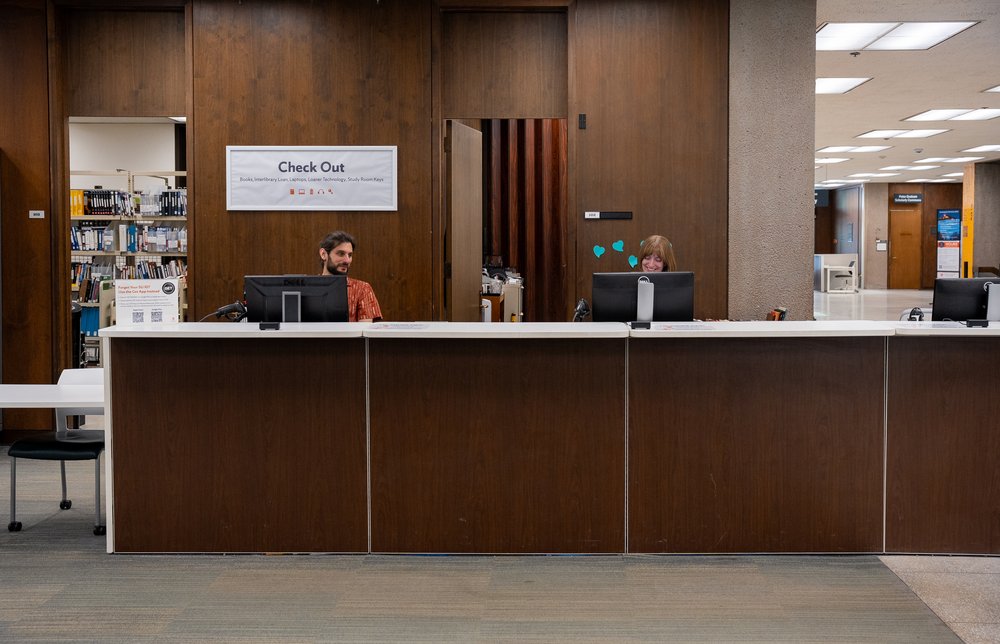
As the head of Access and Resource Sharing, my team of approximately 30 full-time staff and numerous student employees work in three different locations. You’ve certainly seen us at the Check Out Desk in Bird or Carnegie Libraries, offering technology or printing assistance, shelving books and maybe even conducting a book repair workshop. We also staff the Libraries’ Facility, an offsite high density, climate-controlled storage and service complex where library resources are preserved for access when needed. Or maybe you’ve seen one of my team members driving the Libraries’ van, delivering materials from our collections to the office of faculty members.
Over the past year and a half, Access and Resource Sharing has taken on a couple of new initiatives that are visible and available to Libraries’ users. We’ve created two massage chair rooms modeled after the MindSpa in the Barnes Center, sensory friendly study rooms in collaboration with the Center for Disability Resources and an updated Prayer and Meditation Room, in consultation with Hendricks Chapel. We’ve also added a Library of Things that include Onondaga County Parks passes, button maker, clothes steamer, utility cart, a ghost hunting kit, karaoke machine, sewing machine and tool kit.
In addition to that, we’ve undergone several initiatives that are less visible to users but important in the Libraries’ operations and processes. Those project include deaccessioning approximately 24,000 physical books (due to duplication, disuse, outdated or digitally available content), inventory review, department restructuring to allow for greater cross-training, lending a significant amount of resources to other libraries in a timely fashion (resulting in discounts when we need to borrow from other libraries), and storage of archival nitrate films in the Facility’s storage freezers for longer preservation.
Here are some numbers from FY2025 to put my team’s work into context:
- In the Libraries’ Facility we’ve added into storage nearly 4,000 items, bringing the total number of items stored to more than 855,000. Of those, nearly 36,000 items are part of our special collections and the other 819,000 are part of our general collections.
- Our preservation team worked on 5,300 items, provided outreach including tours and instruction to more than 300 people, and had 745,000 YouTube page views (we’re a leader for people and organizations looking for direction on how to care for a ‘wet’ book).
- We circulated, or checked out, over 97,500 items. Of those, 32,000 were study rooms, 36,500 were technology items, and 3,500 were wellness items or the massage chair and prayer and meditation rooms. We offer over 100 laptops for borrowing and 450 other technology items and gear.
- We provided 5,500 documents delivered electronically, we borrowed from other libraries 6,600 items for Syracuse University users, we lent 31,700 to other libraries, we provide more than 100 alternate formats for people with disabilities, we retrieved 2,300 items from the shelves for user pickup, we delivered more than 5,000 items to faculty offices and pick up 2,800 from faculty offices, and we shipped more than 200 items to affiliates in other areas.
In the coming academic year, we are looking forward to continuing to serve the students, faculty and staff across the University. We routinely ask for input on how we can improve the services we provide and are eager to support the evolving needs of our campus community. If you have suggestions, feel free to email us at libref@syr.edu.